Integralmédica / Darkness
Two supplement brands under one admin — and a pile of business rules Shopify doesn't ship. Where Shopify had no answer, I built the app.
- Client
- Integralmédica · Darkness
- Role
- Tech lead · Front-end · Shopify apps
- Year
- 2025
- Stack
- Shopify HydrogenRemixOxygenShopify FunctionsCustom appsTypeScript
- In production
- integralmedica.com.br ↗darkness.com.br ↗
What I owned
- 01Tech lead from mid-project to launch: two headless storefronts sharing one admin and one repository.
- 02Promotion rules as Shopify Functions, and the custom apps, including the employee discount with an inverted calculation.
- 03The account area rebuilt from scratch per brand, and the checkout extensions.
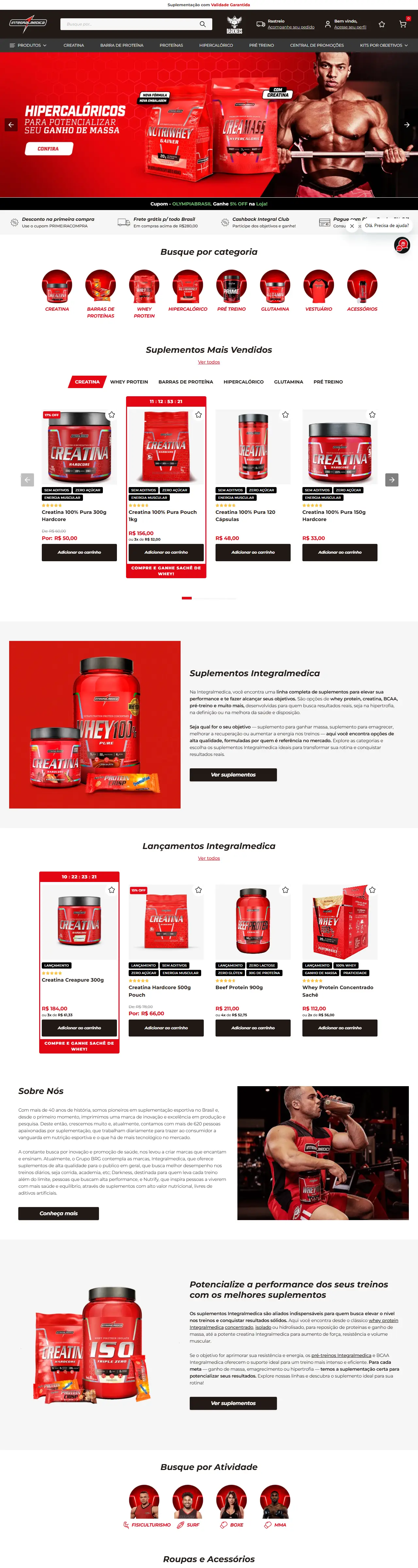
1280 × 800

390 × 844
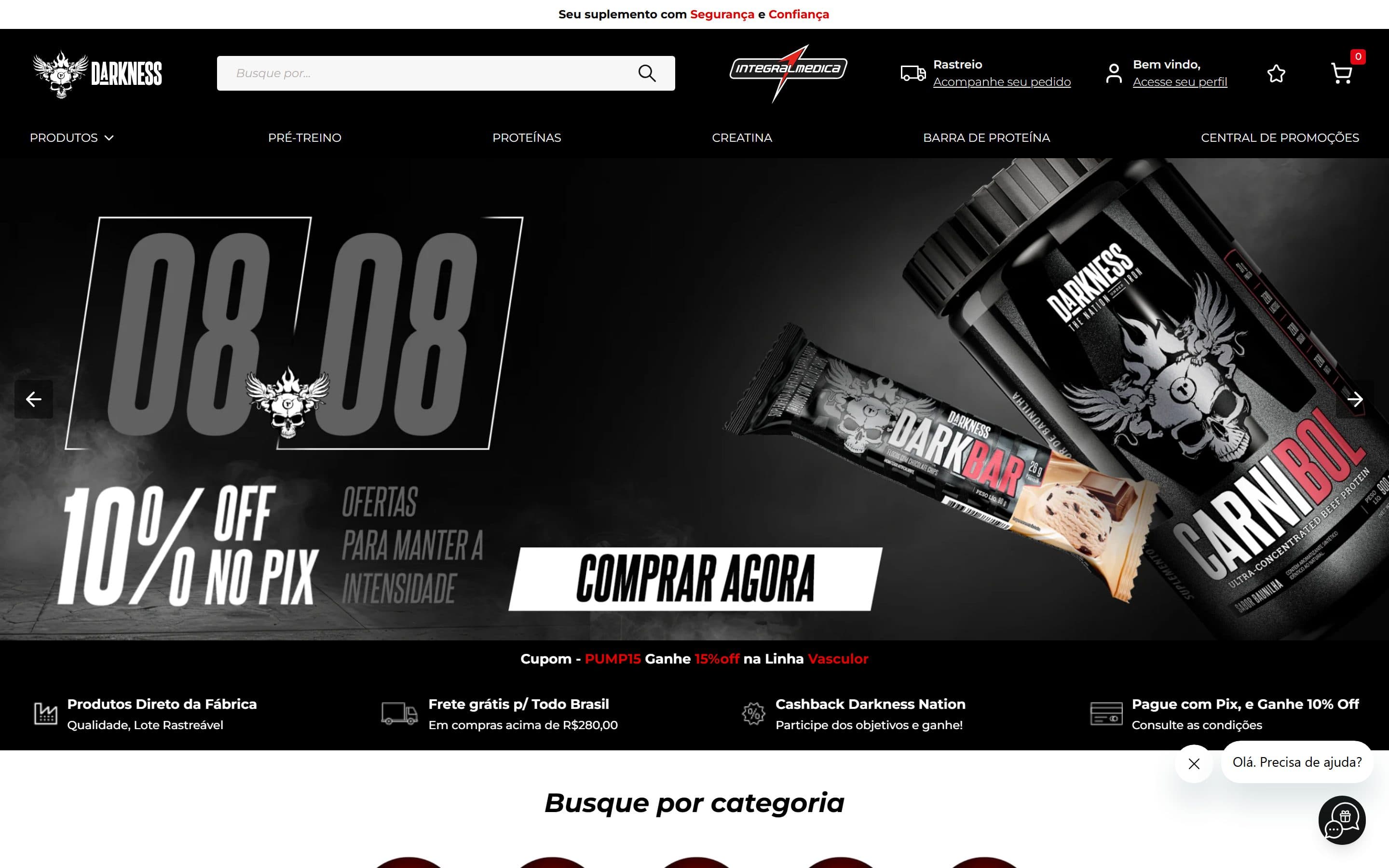
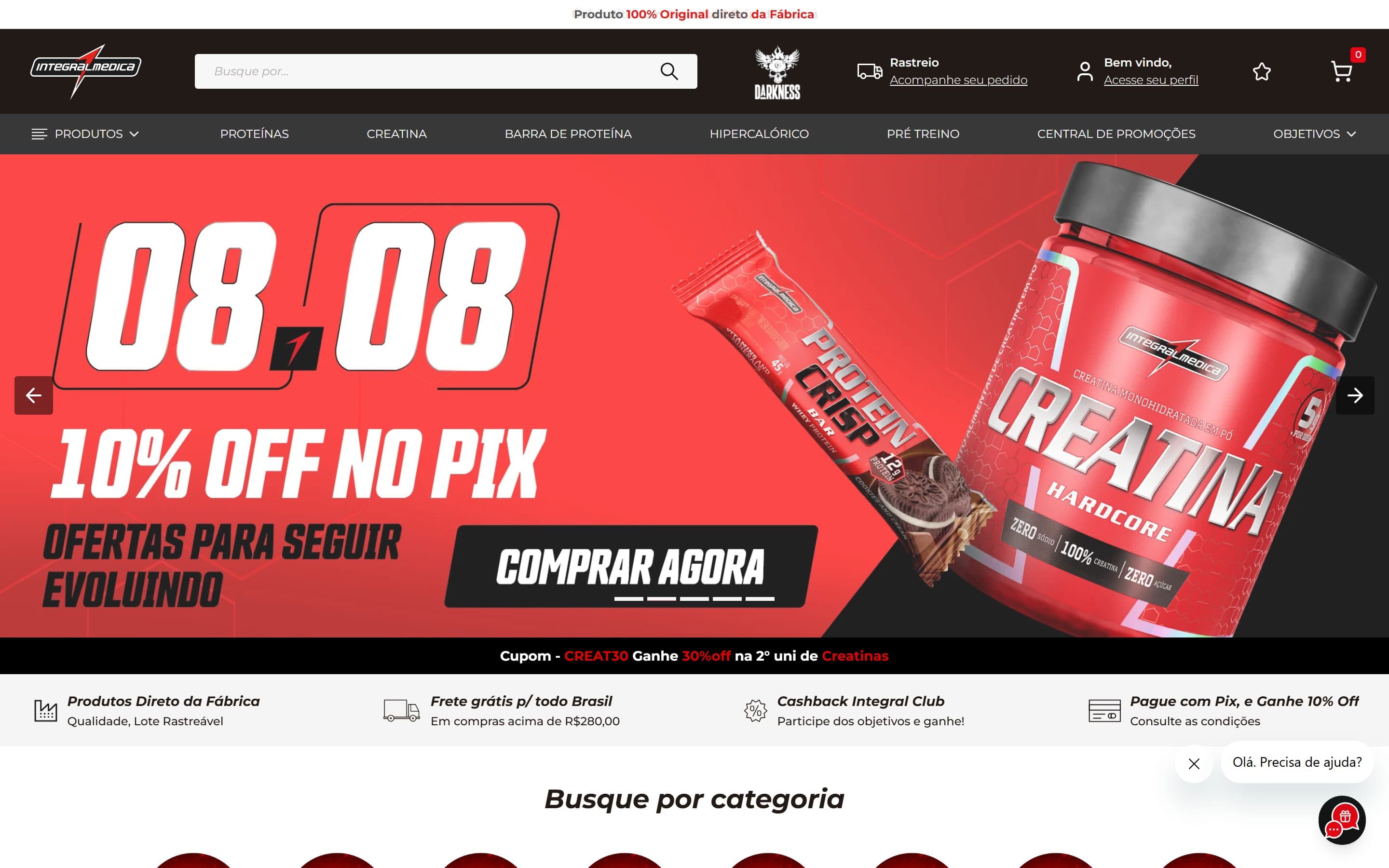
Problem ·Integralmédica and Darkness are two supplement brands run from one Shopify admin. Out of the box, that means the same account page for both, and promotions Shopify can't do.
FIG. 2One admin, two brands — and the layers Shopify didn't ship.
Simple to state, impossible to configure
Employee discount, computed from the compare-at price instead of the selling price. Every off-the-shelf app does the latter. So it became an app.
Simulation. Illustrative data, real mechanism.
R$ 74,95
price × 0.5
R$ 99,95
compareAt × 0.5
Difference per item: R$ 25,00
Context
Integralmédica and Darkness are supplement brands sharing one Shopify admin and one repository: two headless storefronts with a cart shared between them. I joined halfway through development and took over as tech lead. From then on, every feature and every decision went through me, and I built most of the features myself.
The core technical problem
The shared cart was the known part. What made this project hard was something else: the sheer volume of business rules that simply don't exist in off-the-shelf Shopify. Supplements are a category with heavy promotional mechanics, and the client's requirements ran straight into the limits of the native checkout and account area. The recurring question wasn't “how do I configure this?” but “this doesn't exist, so what do we build?”
What I built
- Promotional mechanics as Shopify FunctionsDiscount and promotion rules the platform doesn't ship natively, implemented as Functions running on Shopify's side instead of as hacks in the front-end.
- Purpose-built custom appsSeveral in-house apps, with their own interfaces, covering what no marketplace app solved.
- Employee discount with an inverted calculationAn app with its own interface where the discount doesn't come off the selling price: the math starts from the compare-at price and takes 50% off that. A rule that's simple to state and impossible to configure in an off-the-shelf app.
- Account area rebuilt from scratchShopify's native account area was dropped and rebuilt end to end: per-brand identity, control over how orders are displayed and filtered, and tabs the native one can't have, like “My benefits,” wired into the loyalty program.
- Checkout blocksCheckout extensions that bring information and features into the most sensitive step of the purchase.
- Reporting and data integrationsA range of reports, CRM integrations and third-party script integrations, with a significant amount of data flowing out of the store.
- Brand sections and landing pagesDeeply customizable sections and pages, so the content team can work without waiting on a deploy.
Why it's built this way
- The native account doesn't survive two brandsShopify gives you one account area per admin — and here one admin serves two brands. In practice, that means identical styling for Integralmédica and Darkness, without even a per-brand logo: half the customers would log in and see the other brand. On top of that, there's no control over how orders are displayed or filtered, and no way to add a tab, and we needed “My benefits,” wired into the loyalty program. Rebuilding the whole account area was cheaper than fighting all three limits at once.
- A custom app instead of a marketplace subscriptionThe promotion the client wanted doesn't exist natively. The obvious path was to subscribe to an App Store app and move on, adding a permanent monthly line to their budget. I built a custom app instead: once it's installed and the gift products are configured, it needs no recurring maintenance and has no subscription. I traded a permanent monthly cost for a one-time build cost, and that only makes sense because the rule is stable. If the mechanic changed every campaign, the off-the-shelf app would win.
- Promotion rules on Shopify, not in the front-endThe promotional mechanics were implemented as Shopify Functions, on the platform side. A discount that only exists in the front-end is a discount that vanishes at checkout — and checkout is where the customer decides whether they trust the store.
Status
Integralmédica and Darkness are in production. Both storefronts are live if you want to inspect them.